
Choosing an electric bike requires more than comparing motor wattage or advertised riding range. Battery capacity, frame geometry, tire size, suspension, braking systems, rider fit, and intended use all influence whether a particular e-bike is right for you.
Kingbull is an electric bike brand offering a selection of commuter, mountain, folding, cargo, and all-terrain electric bikes. Its catalogue includes models such as the Ranger, Hunter 2.0S, Expedition, Literider 2.0, Rover 2.0, Voyager 2.0, and Discover 2.0.
But which Kingbull model should you consider? Is a fat-tire e-bike suitable for daily commuting, and how much should you rely on the advertised battery range?
This guide examines Kingbull’s current product lineup, compares selected technical specifications, explains important e-bike buying considerations, and reviews the company’s published shipping, return, and warranty terms.
Editorial note: This guide is based on Kingbull’s official website and published product specifications. CatchOffers has not independently tested these bikes, verified their real-world range, or evaluated their long-term reliability.
What Is Kingbull?
Kingbull is an electric bike brand focused on different riding environments, including urban commuting, outdoor exploration, cargo transportation, and off-road riding.
According to its official About Us page, the company’s published history includes bicycle manufacturing dating back to 2010, electric bike manufacturing from 2020, and a dedicated branding phase beginning in 2023.
Kingbull describes its mission as providing electric bikes for different riding preferences rather than offering a single design for every customer.
Its US catalogue currently organizes products around categories such as:
- Commuter electric bikes.
- Mountain and fat-tire electric bikes.
- Folding electric bikes.
- Cargo electric bikes.
- Full-suspension electric bikes.
- Step-through and step-over frame designs.
- Electric bike accessories and replacement components.
The brand’s website also provides model-specific technical specifications, assembly resources, and warranty information.
You can explore the current lineup at the official Kingbull website.
What Can You Buy at Kingbull?
Kingbull offers several electric bike designs, each targeting a different combination of riding style, storage needs, and terrain.
1. Kingbull Ranger: Vintage Moped-Style Electric Bike
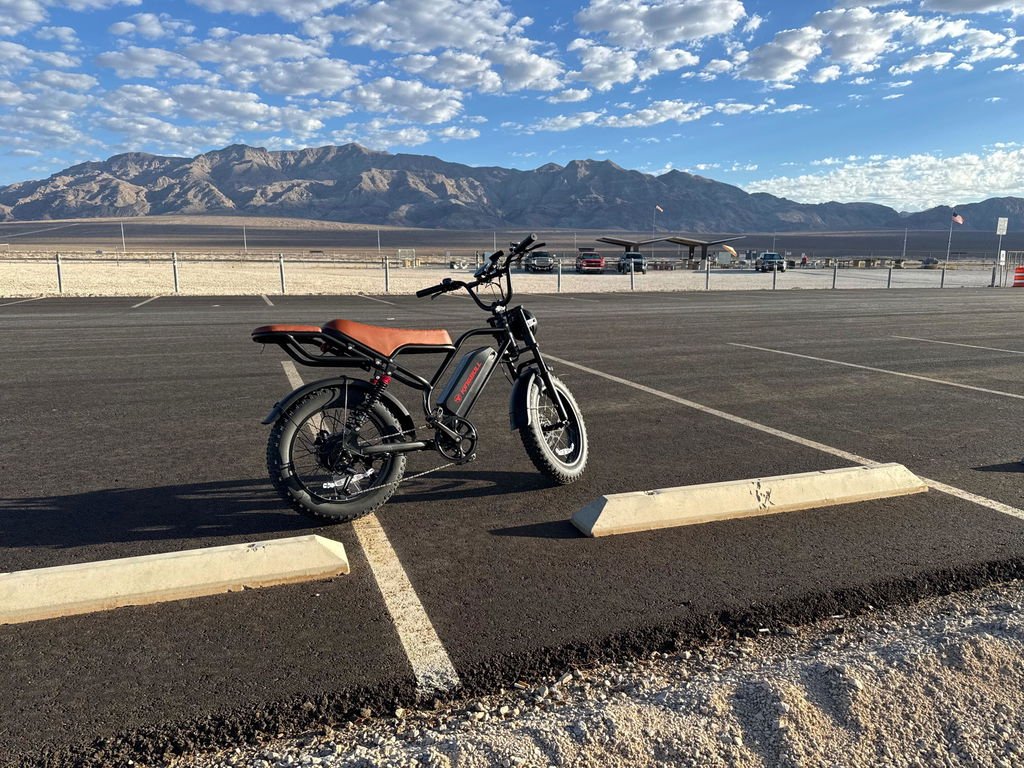
The Kingbull Ranger combines a vintage-inspired moped-style appearance with fat tires and electric assistance.
Its design features a compact frame, wide 20 × 4.0-inch tires, a front suspension fork, rear suspension, and an extended seat.
According to the official product listing, its main specifications include:
- 750W motor.
- Up to 1300W peak motor power.
- 48V 18Ah battery.
- 864Wh battery capacity.
- Up to 80 miles of advertised range.
- Advertised maximum speed of 28 mph.
- Hydraulic braking system.
- Shimano seven-speed drivetrain.
- 85Nm torque.
The 80-mile range is Kingbull’s advertised maximum under its stated conditions, not a guaranteed distance for every rider.
The Ranger may be worth comparing if you like its vintage styling and want a fat-tire electric bike for recreational riding and selected commuting applications.
Before choosing it for everyday use, consider its frame dimensions, weight, seating position, and the practical storage space required.
Visit the official Kingbull Ranger product page for its complete specifications.
2. Kingbull Hunter 2.0S: Mountain Fat-Tire Electric Bike
The Hunter 2.0S is positioned as a mountain and all-terrain fat-tire electric bike.
Compared with the Ranger’s smaller wheel configuration, the Hunter 2.0S uses 26 × 4.0-inch tires and is designed around a more traditional mountain-bike-style frame.
Its published specifications include:
- 750W brushless hub motor.
- Up to 1300W peak power.
- 85Nm torque.
- 48V 18Ah lithium battery.
- 864Wh battery capacity.
- Up to 80 miles of advertised range.
- Maximum speed of 28 mph.
- Dual hydraulic brakes.
- Shimano seven-speed drivetrain.
- Front suspension fork with lockout.
- IPX6 water-resistance rating stated by the manufacturer.
- 400 lbs maximum payload capacity.
The product page also lists a bike weight of approximately 77 lbs and a recommended rider-height range of 5’3″–6’6″.
The Hunter 2.0S may be worth examining if you want wider tires, more traditional mountain-bike proportions, and a higher-capacity frame configuration for off-road-oriented riding.
Its 26 × 4.0-inch tires are an important specification to consider. They can be useful on selected loose surfaces, but tire width alone does not establish how well a bike handles every trail.
Also note that a maximum payload rating includes the relevant load specified by the manufacturer. Do not confuse the total payload with the weight limit of an individual rear rack.
Compare the current specifications on the official Hunter 2.0S product page.
3. Kingbull Expedition: Long-Range Moped-Style E-Bike
The Kingbull Expedition is a larger all-terrain, moped-style electric bike.
Its most distinctive specification is its 48V 31.5Ah battery, rated at 1512Wh by the manufacturer.
The main published specifications include:
- 750W brushless hub motor.
- Up to 1300W peak power.
- 48V 31.5Ah lithium battery.
- 1512Wh battery capacity.
- Up to 120 miles of advertised range under ideal riding conditions.
- Maximum speed of 28 mph.
- Full-suspension design.
- Hydraulic braking system.
- Five levels of pedal assistance.
- Approximately 94 lbs bike weight.
- Recommended rider-height range of 5’1″–6’5″.
Kingbull also lists optional front and rear basket configurations for the Expedition.
The larger battery makes this model particularly interesting for shoppers comparing battery capacity and advertised range. However, it is also considerably heavier than some of the other bikes in the catalogue.
That weight can matter when lifting the bike, transporting it, storing it indoors, or loading it into a vehicle.
If you prioritize a larger battery and a moped-style design, compare the Expedition with the Ranger rather than assuming that the longer range automatically makes it the better choice.
See the official Kingbull Expedition product page for full specifications and size information.
4. Kingbull Literider 2.0: Folding Fat-Tire Electric Bike
The Literider 2.0 is listed as an all-terrain folding electric bike.
Its folding design is an important consideration for shoppers with limited storage space or those who need to transport their bike occasionally.
The current collection page lists:
- 750W motor.
- 720Wh battery.
- 28 mph maximum advertised speed.
- Up to 55 miles of advertised range.
Its 20-inch fat-tire design provides a different riding configuration from the larger-wheel Hunter 2.0S.
Before purchasing, check the folded dimensions, bike weight, available storage space, and the manufacturer’s folding instructions.
A folding frame does not automatically make a heavy fat-tire e-bike convenient to carry. The actual weight and folded size should determine whether the design is practical for your situation.
You can compare the Kingbull Literider 2.0 through the official electric bike catalogue.
5. Kingbull Rover 2.0: Full-Suspension Off-Road E-Bike
The Rover 2.0 is another model to consider when comparing off-road-oriented bikes.
Its collection listing specifies:
- 750W motor.
- 720Wh battery.
- 28 mph maximum advertised speed.
- Up to 60 miles of advertised range.
The product is positioned around all-terrain riding, with full-suspension construction listed in the product presentation.
If you regularly ride on uneven surfaces, suspension design, braking performance, tire specifications, frame geometry, and maintenance requirements deserve close attention.
Compare the Rover’s specifications with the Hunter 2.0S before choosing. A larger advertised range is only one part of the decision, and the two bikes have different battery configurations.
6. Kingbull Voyager 2.0: Cargo Electric Bike
Kingbull also offers the Voyager 2.0, which is presented as a fat-tire electric cargo bike.
The catalogue identifies a configuration with optional trailer packaging and accessories.
Its current listing includes:
- 750W motor.
- 720Wh battery.
- 28 mph maximum advertised speed.
- Up to 60 miles of advertised range.
The Voyager may be worth exploring if carrying equipment or everyday cargo is part of your riding routine.
Before purchasing, review the manufacturer’s actual payload and rack limits, the optional trailer configuration, and whether the accessories shown in photographs are included in the price.
A cargo-oriented bike should be evaluated by its usable carrying capacity and frame suitability rather than appearance alone.
7. Kingbull Discover 2.0 and Discover ST 2.0: Urban and Everyday Riding
The Discover 2.0 and Discover ST 2.0 are listed as premium off-road and city electric bikes.
Both models are presented with:
- 750W motor.
- 720Wh battery.
- 20 mph maximum advertised speed.
- Up to 60 miles of advertised range.
Their frame styles differ, with the collection listing separate step-over and step-through configurations.
A step-through frame may be more convenient for some riders when mounting and dismounting, while a step-over frame offers a different traditional bicycle configuration.
Consider the frame design, rider-height compatibility, seat adjustment, and overall riding posture before selecting a model.
The Discover lineup is worth comparing if your priorities are everyday mobility and a lower stated maximum speed than the higher-speed models in the catalogue.
Kingbull E-Bike Comparison: Key Specifications
The following table brings together specifications published on Kingbull’s current product and collection pages.
| Model | Motor | Battery | Advertised range | Max speed |
|---|---|---|---|---|
| Ranger | 750W (1300W peak) | 864Wh | Up to 80 mi | 28 mph |
| Hunter 2.0S | 750W (1300W peak) | 864Wh | Up to 80 mi | 28 mph |
| Expedition | 750W (1300W peak) | 1512Wh | Up to 120 mi | 28 mph |
| Literider 2.0 | 750W | 720Wh | Up to 55 mi | 28 mph |
| Rover 2.0 | 750W | 720Wh | Up to 60 mi | 28 mph |
| Voyager 2.0 | 750W | 720Wh | Up to 60 mi | 28 mph |
| Discover 2.0 | 750W | 720Wh | Up to 60 mi | 20 mph |
These are manufacturer-published figures, not results from independent testing. Product versions and availability may change.
What Do Motor Wattage and Peak Power Actually Mean?
Motor specifications are among the first things many e-bike shoppers compare.
Kingbull advertises several models with a 750W motor and up to 1300W peak power.
These are two different measurements.
The 750W figure identifies the motor’s stated power rating, while the 1300W figure describes the advertised peak output.
Peak output should not be interpreted as continuous power. It represents a higher power level available under specified operating conditions.
When comparing e-bikes, consider more than these two figures.
Also examine:
- Torque in Newton-meters (Nm).
- Controller specifications.
- Battery voltage and capacity.
- Pedal-assist behavior.
- Throttle configuration.
- Maximum speed.
- Braking equipment.
For example, Kingbull lists 85Nm of torque for the Ranger and Hunter 2.0S. This is relevant when comparing climbing-oriented designs, but actual climbing performance depends on rider weight, slope, battery charge, controller behavior, and the selected riding mode.
A higher peak-wattage headline is not enough to establish which bike is best for everyday use.
Battery Capacity and Advertised Range
Battery capacity is one of the most useful specifications when comparing electric bikes.
Kingbull publishes battery capacity in both amp-hours (Ah) and watt-hours (Wh).
Watt-hours provide a convenient way to compare nominal battery energy across different voltage configurations.
For example:
- Ranger: 864Wh.
- Hunter 2.0S: 864Wh.
- Expedition: 1512Wh.
- Literider 2.0: 720Wh.
- Rover 2.0: 720Wh.
- Voyager 2.0: 720Wh.
- Discover 2.0: 720Wh.
The Expedition has the largest listed battery capacity among these examples.
However, a larger battery does not automatically guarantee a proportionally longer distance on every route.
Actual range can vary according to:
- Rider weight and carried cargo.
- Road or trail surface.
- Elevation changes and climbing.
- Riding speed.
- Pedal-assist level.
- Throttle use.
- Tire pressure.
- Weather and temperature.
- Battery condition.
Kingbull explicitly describes its advertised maximum ranges as conditional on ideal riding conditions.
If you plan to commute a fixed daily distance, calculate a comfortable margin below the manufacturer’s maximum range instead of assuming that every ride will reproduce the headline figure.
How to Choose the Right Kingbull E-Bike
The right model depends on your riding purpose, physical fit, storage arrangement, and local regulations.
Choose Based on Your Riding Environment
For everyday city commuting: Compare the Discover 2.0 and Discover ST 2.0. Their stated 20 mph maximum speed and step-over/step-through frame options make them useful models to examine for urban-oriented riding.
For vintage styling and recreational riding: Consider the Ranger. Its 20 × 4.0-inch tires, extended seat, and moped-inspired appearance distinguish it from more traditional bicycle designs.
For larger-wheel fat-tire riding: Compare the Hunter 2.0S. Its 26 × 4.0-inch tires, hydraulic brakes, and published suspension specifications are important points to evaluate.
For larger battery capacity: The Expedition is worth comparing because of its listed 1512Wh battery and advertised maximum range of 120 miles.
For limited storage space: Investigate the Literider 2.0 and its actual folded dimensions rather than assuming every folding electric bike is easy to carry.
For cargo transportation: Compare the Voyager 2.0’s available cargo configurations and the model-specific payload information.
Check the Rider Height and Bike Weight
Fit is essential when choosing an electric bike.
Kingbull provides size information for individual models. For example, its Hunter 2.0S listing gives a recommended rider-height range of 5’3″–6’6″, while the Expedition lists 5’1″–6’5″.
Their published weights are also different: approximately 77 lbs for the Hunter 2.0S and 94 lbs for the Expedition.
These differences can affect comfort, control, transport, storage, and loading the bike into a vehicle.
Use the official size charts and geometry diagrams before ordering. Do not select a model based solely on tire size or overall appearance.
Evaluate Brakes and Suspension
Braking and suspension are important safety and handling components.
Kingbull lists hydraulic brakes on selected models, including the Ranger, Hunter 2.0S, and Expedition.
Suspension arrangements also vary. Some models have front suspension, while others are presented with full-suspension designs.
Look at the exact equipment listed for the bike you intend to buy.
For heavier electric bikes and higher-speed models, the braking system, tire condition, frame geometry, and correct setup deserve particular attention.
Check Local E-Bike Regulations
An e-bike’s legal classification is not determined by its appearance or marketing category alone.
Kingbull lists models with different maximum speeds, including 20 mph and 28 mph products.
The permitted motor output, speed assistance, throttle operation, and vehicle classification can differ between jurisdictions.
Before ordering, check the laws that apply where you intend to ride. Confirm whether the bike can be used on public roads, bicycle paths, trails, and other designated areas.
Do not assume that a model sold as an electric bike is automatically permitted on every road or cycling path.
Assembly, Maintenance, and Replacement Parts
Kingbull states that its electric bikes arrive approximately 85% pre-assembled. Some assembly work is still required before the first ride.
The company provides assembly instructions and model-specific resources through its official website.
Before riding, follow the manual and check that all required components are fitted and adjusted correctly.
Important checks include:
- Handlebar and stem installation.
- Front-wheel installation and alignment.
- Brake adjustment.
- Tire pressure.
- Battery installation and charging.
- Seat and handlebar adjustment.
- Lighting and display operation.
- Fasteners and other assembly points.
For ongoing maintenance, follow the manufacturer’s instructions for battery storage, tire pressure, brake inspection, drivetrain lubrication, and general cleaning.
Ask Kingbull about replacement batteries, chargers, displays, and other components if long-term parts availability is important to your decision.
Avoid unauthorized repairs or modifications that may affect warranty eligibility.
Kingbull Shipping: What Buyers Should Know
Shipping is an important consideration for a large product such as an electric bike.
Kingbull’s current US Shipping Policy states that free shipping is offered to the lower 48 states in the United States.
The company specifically states that it does not ship to PO boxes or APO addresses.
Its published shipping information indicates:
- In-stock orders typically ship within two business days.
- Tracking information is generally provided within two business days.
- Bikes are shipped from US warehouses.
- Estimated delivery is approximately two to seven business days, depending on the destination.
- UPS and FedEx are among the carriers used.
- Delivery estimates may change because of carrier, weather, and transportation conditions.
The policy also states that some accessories may be shipped internationally, with an estimated seven-to-ten-day delivery period. This does not establish international shipping availability for complete e-bikes.
For customers outside the United States, including Vietnam: the US policy only confirms free bike shipping to the lower 48 states. It does not establish that complete bikes can be delivered internationally. Confirm availability with Kingbull or the appropriate regional retailer before purchasing.
It is also important to understand the cancellation terms after shipment. The retailer states that cancelling after dispatch may involve a 10% processing charge and a $150 return shipping fee.
Read the official Kingbull Shipping Policy before completing an order.
Kingbull Returns and Refunds
Kingbull publishes a 15-day return and refund policy.
However, the detailed conditions are more restrictive than the simple 15-day return badge shown on the website.
According to the official Return & Refund Policy:
- Returns must be requested and approved by email.
- A return merchandise authorization (RMA) is required.
- Bikes must be unused and in the same condition as received.
- Original packaging, manuals, accessories, battery, charger, keys, and other included components must be returned.
- Bikes with more than 10 miles of total mileage are not eligible for refunds.
- All refunds and returns must be initiated within 15 days of receipt.
- Accessories other than bikes are generally non-returnable.
For returns that are not related to a qualifying product-quality issue, customers are responsible for return shipping.
The policy lists a $150 return shipping fee per e-bike, or $230 for customers with Hawaii shipping addresses, together with a 10% handling fee.
These conditions mean that the advertised 15-day return period should not be interpreted as an unrestricted, no-cost trial.
Before ordering, review the complete policy and confirm the applicable charges for your order.
Read the official Return & Refund Policy.
Kingbull Warranty: Is Everything Covered for Two Years?
Kingbull advertises a two-year warranty on its website, but the detailed warranty policy shows different coverage periods for different components.
The published US warranty applies to eligible products purchased in the United States on or after August 7, 2023.
For the original retail purchaser, the current policy lists:
| Component | Published warranty |
|---|---|
| Motor | 2 years |
| Battery | 2 years |
| Controller | 2 years |
| Sensors and wiring | 2 years |
| Frame | 2 years |
| Display | 1 year |
| Forks | 1 year |
| Hub | 1 year |
| Charger | 6 months |
| Hydraulic brake system | 3 months |
| Tires | 3 months |
Coverage is subject to the warranty conditions. Normal battery-capacity degradation, ordinary wear, damage caused by accidents, improper use, unauthorized repairs, and certain modifications are excluded.
Warranty Restrictions for International Buyers
Kingbull’s published warranty explicitly covers eligible purchases made in the United States.
The policy also reserves the right to limit warranty service to the country where the product was originally purchased.
This means international shoppers should not assume that buying from the US website automatically provides the same warranty service in their home country.
Before purchasing, confirm which regional warranty applies, where repairs can be performed, and who pays for replacement-part shipping.
You can review the official Kingbull Warranty Information.
What Are the Main Advantages and Limitations of Kingbull?
Based on the current product catalogue and published policies, there are several practical considerations worth comparing.
Potential Advantages
Multiple electric bike categories. Kingbull offers commuter, mountain, folding, cargo, and all-terrain designs.
Different battery capacities. The current lineup includes models with 720Wh, 864Wh, 960Wh, 1440Wh, and 1512Wh configurations.
Several frame and tire designs. Shoppers can compare step-through and step-over frames, smaller fat-tire configurations, and larger-wheel models.
Detailed product specifications. Individual listings provide information about motor power, battery capacity, speed, range, weight, rider height, braking systems, and other components.
Published owner resources. The company provides assembly manuals, warranty information, product support, and other resources.
Important Considerations
Advertised maximum range is not guaranteed. Real-world results depend on riding conditions, payload, speed, and battery use.
Some bikes are heavy. Models such as the Expedition weigh approximately 94 lbs, which can make transport and storage more difficult.
Return costs can be substantial. Non-quality-related returns may involve a $150 shipping charge per e-bike plus a handling fee.
Warranty coverage varies by component. Not every component receives two years of coverage.
The US store has restricted shipping destinations. The published bike shipping policy covers the lower 48 states and excludes PO boxes and APO addresses.
Local legality must be checked. Models with different maximum speeds and power configurations may be treated differently under local regulations.
These points are drawn from Kingbull’s published information. They do not establish independent conclusions about the bikes’ real-world durability or performance.
Is Kingbull Worth Considering?
Kingbull is worth researching if you want to compare fat-tire, commuter, folding, cargo, and all-terrain electric bikes.
Its lineup offers different battery capacities and frame designs, allowing shoppers to focus on their intended riding environment rather than choosing solely by motor wattage.
The Ranger may appeal to shoppers who prefer its vintage moped-style appearance. The Hunter 2.0S is worth comparing for its 26 × 4.0-inch tires and mountain-oriented specifications. The Expedition is notable for its larger 1512Wh battery and its advertised maximum range of 120 miles.
However, none of these specifications independently establishes that a bike will be the best choice for your situation.
The most important factors are rider fit, actual intended use, braking equipment, battery requirements, storage, local regulations, and the retailer’s after-sales conditions.
CatchOffers has not conducted independent ride testing or durability testing, so this guide cannot establish that Kingbull is better or worse than competing electric bike brands.
The bottom line: Kingbull offers a varied range of electric bikes worth comparing, especially if you are interested in fat-tire designs, larger battery configurations, or moped-style frames. Evaluate the exact model, calculate your expected riding needs, and understand shipping, return, and warranty conditions before committing to a purchase.
Frequently Asked Questions
What is Kingbull known for?
Kingbull is known for electric bikes covering commuter, mountain, fat-tire, folding, cargo, and all-terrain categories.
What is the most long-range Kingbull electric bike?
The Kingbull Expedition is currently listed with a 1512Wh battery and an advertised maximum range of up to 120 miles under ideal riding conditions. Actual range varies according to the rider and environment.
Is the Kingbull Hunter 2.0S suitable for off-road riding?
Kingbull markets the Hunter 2.0S as a mountain fat-tire electric bike. Its product page lists 26 × 4.0-inch tires, a 750W motor with up to 1300W peak power, 85Nm torque, hydraulic brakes, and a front suspension fork.
What is the difference between the Ranger and Hunter 2.0S?
Both list a 750W motor, up to 1300W peak power, an 864Wh battery, and up to 80 miles of advertised range. The Ranger uses 20 × 4.0-inch tires and a vintage moped-style frame, while the Hunter 2.0S uses 26 × 4.0-inch tires and a mountain-bike-style frame.
Does Kingbull ship internationally?
The US shipping policy confirms free bike shipping to the lower 48 states. It does not establish international delivery availability for complete e-bikes. Confirm the relevant regional shipping arrangements before purchasing.
Does Kingbull offer free shipping?
The US website states that free shipping is available to the lower 48 states, subject to its shipping policy and applicable exclusions.
How long is the Kingbull warranty?
The original US retail purchaser receives two years of coverage for eligible components such as the motor, battery, controller, sensors, wiring, and frame. Other components have shorter warranty periods.
Can I return a Kingbull electric bike?
Kingbull publishes a 15-day return and refund policy. The bike must meet the stated condition requirements, and a return must be approved. Non-quality-related returns may incur a $150 shipping fee and a 10% handling fee. Bikes with more than 10 miles of total mileage are not eligible for refunds under the published policy.
Where can I buy Kingbull electric bikes?
Visit the official Kingbull website to compare current models, technical specifications, product availability, and purchase terms.
Affiliate Disclosure: CatchOffers may earn a commission when you purchase through qualifying affiliate links, at no additional cost to you. Product specifications, prices, promotions, availability, shipping arrangements, return conditions, and warranty coverage may change. Always confirm the latest details on Kingbull’s official website before placing an order.

