
Choosing a 3D printer involves more than comparing printing speed and build volume. Printing technology, material compatibility, color capabilities, software, maintenance requirements, and the intended application all influence which machine is the right choice.
Flashforge is a 3D printing manufacturer offering desktop printers, multi-color printing systems, professional equipment, filaments, and printing accessories.
Its current product portfolio includes the Adventurer series, AD5X multi-color printer, Creator 5 series with four independent toolheads, and CJ270 full-color 3D printer.
The company also offers different printing materials, including PLA, PETG, carbon-fiber-reinforced filaments, and specialized resin for the CJ270.
This Flashforge review explores the company’s product lineup, important printing technologies, popular models, material compatibility, software, and purchasing policies. It is based on publicly available manufacturer information rather than independent laboratory testing or hands-on product reviews.
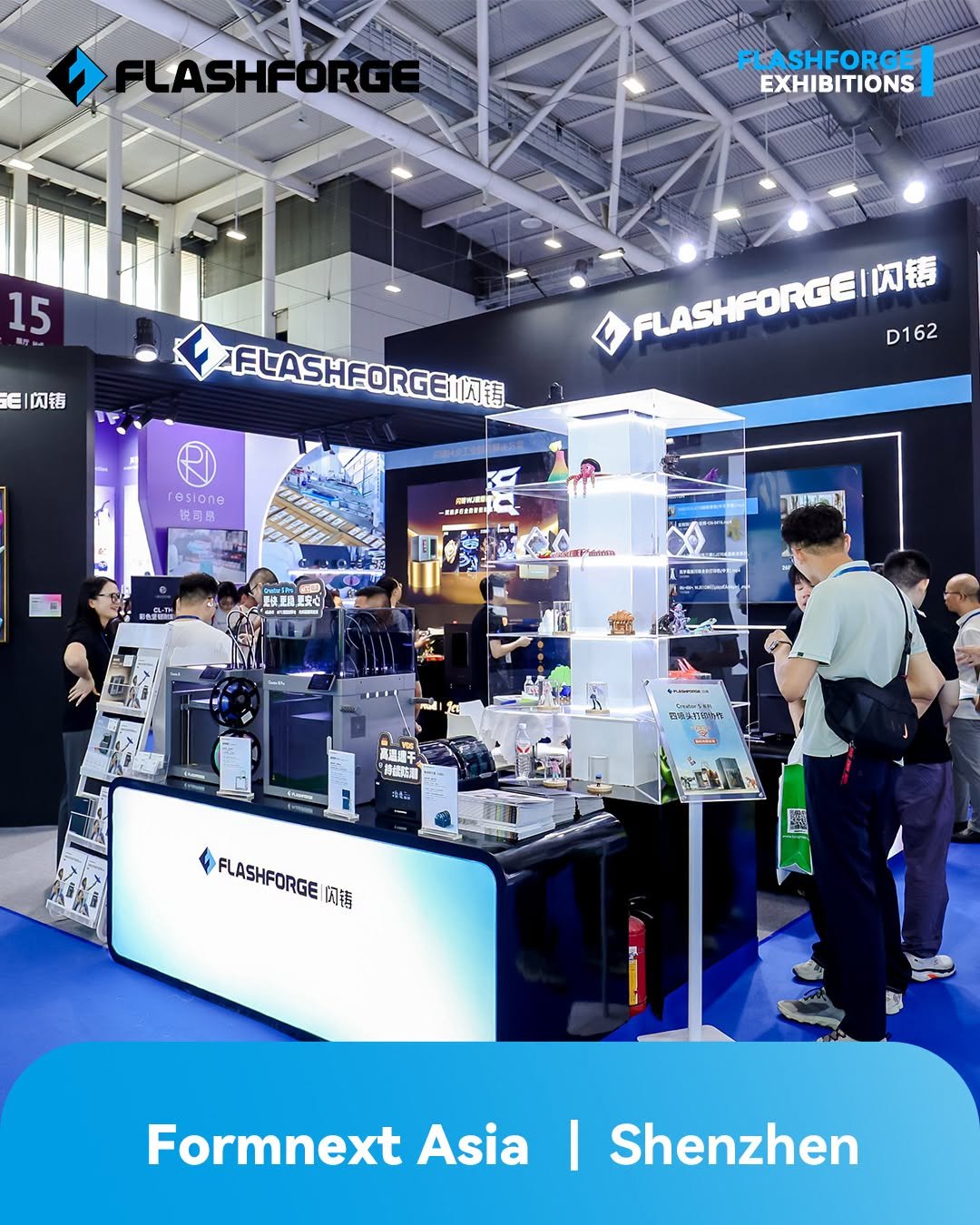
1. What Is Flashforge?
Flashforge is a manufacturer specializing in 3D printers, printing materials, and related equipment.
According to its official About Us page, Zhejiang Flashforge 3D Technology Co., Ltd. was founded in 2011.
The company focuses on providing 3D printing solutions for individual creators, educational institutions, design studios, and professional applications.
Its product ecosystem includes:
- Desktop FDM 3D printers.
- Multi-color and multi-material 3D printers.
- Enclosed 3D printers.
- Professional full-color printing systems.
- PLA, PETG, TPU, and engineering filaments.
- Specialized resin materials.
- Nozzles, build plates, extruder components, and accessories.
- Slicing software and printer management applications.
Flashforge’s approach is to offer different machines for different levels of 3D printing, from relatively accessible desktop printers to advanced multi-material systems.
Official website: https://www.flashforge.com/
2. Understanding Flashforge Printing Technologies
Before comparing individual machines, it is useful to understand the printing technologies used across Flashforge’s current product range.
FDM 3D Printing
Fused Deposition Modeling (FDM), also commonly referred to as Fused Filament Fabrication (FFF), is one of the most widely used 3D printing methods.
An FDM printer feeds thermoplastic filament through a heated nozzle, which deposits material layer by layer to create a three-dimensional object.
Flashforge offers several FDM printers using this approach.
Common supported materials across selected models include:
- PLA.
- High-Speed PLA.
- PETG.
- TPU.
- ABS.
- ASA.
- PLA-CF.
- PETG-CF.
- PA-CF.
The exact supported materials depend on the printer, nozzle, chamber conditions, and manufacturer’s recommendations.
FDM printing is suitable for applications such as:
- Prototyping.
- Functional parts.
- Mechanical components.
- Replacement parts.
- Decorative objects.
- Educational projects.
- Small-batch manufacturing.
Multi-Color FDM Printing
Flashforge offers two different approaches to multi-color FDM printing.
Intelligent Filament System (IFS)
The AD5X uses an integrated Intelligent Filament System that manages multiple filament feeds through one extruder.
The system automatically changes the selected filament during printing, enabling multi-color projects without manual filament replacement.
Four Independent Toolheads
The Creator 5 series uses four independent toolheads.
Instead of routing multiple filaments through one extruder, the printer has four separate printing heads that can be assigned different materials or colors.
This enables multi-material printing and reduces the need for conventional filament-purging operations during material changes.
These technologies serve similar goals but use different mechanical designs and workflows.
Multi Jet Printing (MJP)
Flashforge’s CJ270 represents a different approach to 3D printing.
Instead of extruding thermoplastic filament, MJP uses inkjet printheads to deposit specialized printing materials layer by layer.
The CJ270 combines CMYK, white, and clear materials to produce full-color models.
Flashforge advertises more than 10 million color combinations and a layer thickness of 7 micrometers.
This printing technology is designed for highly detailed, full-color models, prototypes, educational projects, and creative applications.
It should not be confused with conventional multi-color FDM printing, where different filament colors are selected and deposited by extruders.
3. Flashforge 3D Printer Product Categories
Flashforge’s current highlighted range includes several main product families.
Adventurer Series
The Adventurer series is positioned around accessible desktop 3D printing.
Models such as the Adventurer 5M and Adventurer 5M Pro focus on simplifying setup and everyday printing.
Depending on the model, features include:
- Automatic bed leveling.
- Direct-drive extrusion.
- Quick-release nozzle assemblies.
- Flexible PEI build plates.
- Filament runout detection.
- Power-loss recovery.
- Wi-Fi connectivity.
- Remote monitoring on supported versions.
The Adventurer 5M is an open-frame machine, while the Adventurer 5M Pro uses an enclosed design with additional air filtration.
This product family is relevant to beginners, home users, educators, and creators who want an accessible FDM printing workflow.
Official collection: https://www.flashforge.com/collections/3d-printers
AD5X Multi-Color Printer
The AD5X is designed for users who want to produce multi-color prints without manually changing filament throughout a project.
Its integrated Intelligent Filament System manages multiple filament inputs.
The system supports up to four colors in a multi-color printing workflow.
Its main features include:
- CoreXY motion structure.
- Integrated IFS.
- Four-color printing.
- Automatic bed leveling.
- Power-loss recovery.
- Filament detection.
- PEI flexible steel build plate.
- USB, Wi-Fi, and Ethernet connectivity.
The AD5X is positioned as a relatively accessible entry point into automated multi-color FDM printing.
Official product page: https://www.flashforge.com/products/flashforge-ad5x-3d-printer
Creator 5 Series
The Creator 5 series represents a more advanced approach to multi-color and multi-material FDM printing.
Both Creator 5 and Creator 5 Pro feature four independent toolheads.
This design allows different materials to be assigned to individual printing heads.
Potential applications include:
- Multi-color models.
- Functional prototypes.
- Multi-material parts.
- Models combining rigid and flexible materials.
- Professional product development.
The Creator 5 uses an open-frame design, while the Creator 5 Pro adds an enclosed and actively heated chamber.
The two models share the same nominal build volume but have different material-handling and environmental capabilities.
Official collection: https://www.flashforge.com/collections/creator-5-series
CJ270 Full-Color 3D Printer
The CJ270 is Flashforge’s specialized desktop full-color printing system.
It uses Multi Jet Printing technology and specialized resin materials to produce detailed, full-color models.
Its intended applications include:
- Product visualization.
- Character and miniature models.
- Design studios.
- Education.
- Business prototyping.
- Creative production.
Compared with conventional FDM machines, the CJ270 is designed for a different type of output and production workflow.
Its smaller build volume and specialized printing materials should be considered when comparing it with conventional filament-based printers.
Official product page: https://www.flashforge.com/products/flashforge-cj270
4. Popular Flashforge 3D Printer Models
The following models illustrate the main capabilities across Flashforge’s current product lineup.
Flashforge Adventurer 5M Pro
The Adventurer 5M Pro is an enclosed desktop FDM printer designed for convenient everyday printing.
Its official specifications include:
- 220 × 220 × 220 mm build volume.
- Direct-drive extruder.
- 280°C maximum extruder temperature.
- 100°C build platform temperature.
- Up to 600mm/s maximum travel speed.
- Automatic bed leveling.
- Flexible removable PEI steel build plate.
- Filament runout detection.
- Power-loss recovery.
- Camera monitoring.
- Wi-Fi, Ethernet, and USB connectivity.
- Internal and external air circulation with HEPA and activated-carbon filtration.
The enclosed design distinguishes the Pro model from the open-frame Adventurer 5M.
Its filtration system is designed to manage airborne particles and emissions generated during printing, although users should still follow appropriate ventilation and material-handling recommendations.
The Adventurer 5M Pro is particularly relevant to:
- Home users.
- Beginners.
- Educational environments.
- Small workshops.
- Creators working with supported standard and engineering filaments.
Official product page: https://www.flashforge.com/products/adventurer-5m-pro-3d-printer
Flashforge AD5X
The AD5X is an entry-level multi-color FDM printer built around Flashforge’s Intelligent Filament System.
Its key specifications include:
- 220 × 220 × 220 mm build volume.
- One extruder.
- Integrated four-filament IFS system.
- 110°C maximum bed temperature.
- 300°C maximum extruder temperature.
- Up to 600mm/s travel speed.
- Up to 300mm/s print speed.
- Up to 20,000mm/s² acceleration.
- Automatic bed leveling.
- Filament detection.
- Power-loss recovery.
- USB, Ethernet, and Wi-Fi connectivity.
The AD5X’s single-extruder design is important to understand.
It uses the IFS to switch between different filament colors rather than having four independent printing heads.
This makes it suitable for multi-color projects, but filament changes still involve material transitions and purge management.
The AD5X may appeal to:
- Hobbyists interested in multi-color printing.
- Home makers.
- Educational users.
- Creators producing decorative models.
- Users who want a relatively accessible automated multi-color workflow.
Official product page: https://www.flashforge.com/products/flashforge-ad5x-3d-printer
Flashforge Creator 5
The Creator 5 is a four-toolhead FDM printer designed for multi-color and multi-material projects.
Its manufacturer-listed specifications include:
- Four independent toolheads.
- 256 × 256 × 256 mm build volume.
- 120°C maximum bed temperature.
- 320°C maximum extruder temperature.
- 600mm/s maximum travel speed.
- 300mm/s maximum print speed.
- 30,000mm/s² maximum acceleration.
- Automatic bed leveling.
- Dynamic flow calibration.
- Full-color touchscreen.
- Built-in camera.
- USB and Wi-Fi connectivity.
- Compatible Orca-Flashforge and OrcaSlicer software.
The four independent toolheads are its defining feature.
Each toolhead can be assigned a different filament, allowing the machine to switch directly between selected materials during a print.
This can reduce the material waste associated with conventional single-nozzle filament switching.
The open-frame design makes the Creator 5 suitable for general multi-color applications using supported materials such as PLA, PETG, TPU, PLA-CF, and PETG-CF.
However, users should check the material requirements carefully before attempting combinations involving different printing temperatures, shrinkage rates, or adhesion characteristics.
One important detail is that the standard Creator 5 configuration does not include an automatic multi-spool filament feeder. Filaments must be loaded into the individual toolheads, with the software managing their assignment and printing sequence.
Official product page: https://www.flashforge.com/products/flashforge-creator-5
Flashforge Creator 5 Pro
The Creator 5 Pro builds on the four-toolhead architecture of the standard Creator 5.
Its primary difference is the enclosed and actively heated printing chamber.
Key specifications include:
- Four independent toolheads.
- 256 × 256 × 256 mm build volume.
- 120°C maximum bed temperature.
- 320°C maximum extruder temperature.
- Active chamber heating up to 65°C.
- 600mm/s maximum travel speed.
- 300mm/s maximum print speed.
- 30,000mm/s² maximum acceleration.
- HEPA 13 and activated-carbon filtration.
- Automatic multi-toolhead offset calibration.
- Built-in camera.
- USB and dual-band Wi-Fi connectivity.
The actively heated chamber is particularly relevant for materials that are more sensitive to temperature fluctuations during printing.
The manufacturer lists support for several engineering materials, including:
- ABS.
- ASA.
- PA-CF.
- PET-CF.
- PAHT-CF.
- ASA-CF.
- ASA-GF.
- PPA-CF.
- PPS-CF.
- HIPS.
It also supports standard materials such as PLA, PETG, TPU, PVA, and BVOH, subject to the appropriate printing configuration.
The Pro version adds several functions not found on the standard open-frame Creator 5:
- Fully enclosed printing chamber.
- Active chamber temperature control.
- HEPA 13 and activated-carbon filtration.
- Auxiliary cooling.
- Door and top-cover detection.
- Improved support for engineering materials.
For buyers who plan to print ABS, ASA, nylon-based materials, or reinforced composites, the Creator 5 Pro is a more relevant option than the standard open-frame model.
Official product page: https://www.flashforge.com/products/flashforge-creator-5-pro
Flashforge CJ270
The CJ270 is a specialized full-color 3D printer using Multi Jet Printing technology.
Unlike an FDM printer, it does not rely on thermoplastic filament extrusion.
Its official specifications include:
- MJP printing technology.
- 180 × 120 × 100 mm build volume.
- 7μm layer thickness.
- CMYK, white, and clear materials.
- Water-soluble support material.
- Active-carbon air filtration.
- Up to 55dB advertised noise level.
- 697 × 410 × 405 mm machine dimensions.
- Approximately 33.5kg machine weight.
Flashforge advertises more than 10 million color combinations using its CMYK, white, and clear materials.
The printing workflow is designed to produce models with detailed surfaces, color gradients, and transparent effects.
One feature worth understanding is its water-soluble support system.
Instead of requiring all support structures to be removed through manual cutting, users can dissolve compatible support material in water after printing.
Optional post-processing tools include ultrasonic cleaning equipment and UV curing accessories.
The CJ270 is intended for more specialized applications than conventional desktop FDM printers.
Potential users include:
- Product designers.
- Creative studios.
- Educational institutions.
- Character and miniature manufacturers.
- Businesses producing detailed visual prototypes.
Its relatively small build volume and specialized resin workflow make it important to evaluate the intended application before purchasing.
Official product page: https://www.flashforge.com/products/flashforge-cj270
5. Flashforge 3D Printing Materials
Flashforge offers a range of materials designed for different printing applications.
Choosing the appropriate filament or resin is important for obtaining the required strength, flexibility, surface finish, and dimensional stability.
PLA and High-Speed PLA
PLA is commonly used for general-purpose 3D printing.
Its ease of printing makes it suitable for:
- Decorative objects.
- Figurines.
- Prototypes.
- Educational projects.
- General-purpose models.
Flashforge also offers High-Speed PLA, which is formulated for printing workflows designed around higher material flow and faster production.
The manufacturer lists printing speeds of up to 350mm/s for its HS PLA under supported conditions.
This does not mean every printer will achieve that speed with every model.
PETG
PETG offers a combination of strength, flexibility, and durability that makes it useful for functional parts and everyday objects.
Potential applications include:
- Containers.
- Mechanical brackets.
- Prototypes.
- Enclosures.
- Functional components.
PETG is more demanding than basic PLA in some printing situations, so bed adhesion, temperature, and cooling settings should be configured appropriately.
TPU
TPU is a flexible thermoplastic material.
It can be used for:
- Protective covers.
- Flexible mounts.
- Soft grips.
- Shock-absorbing components.
- Flexible mechanical parts.
TPU printing requirements vary depending on material hardness and printer feeding design.
Always check the supported TPU specification for the exact printer.
Carbon-Fiber-Reinforced Filaments
Flashforge lists several reinforced materials, including:
- PLA-CF.
- PETG-CF.
- PET-CF.
- PETG-CF.
- PET-GF.
- ASA-CF.
Carbon-fiber-reinforced filaments can offer improved stiffness and dimensional stability for certain applications.
However, these materials can be abrasive and may require compatible hardened-steel nozzles.
Users should check the printer’s maximum extrusion temperature, nozzle material, and recommended printing configuration before using reinforced filaments.
ABS and ASA
ABS and ASA are engineering-oriented materials used for applications requiring different thermal and mechanical properties from basic PLA.
They generally benefit from a more controlled printing environment.
The Creator 5 Pro is particularly relevant because it provides an enclosed chamber with active heating up to 65°C.
ASA is also commonly considered for parts intended for outdoor use because of its weathering characteristics.
Actual material performance depends on formulation, printing conditions, and end-use requirements.
CJ270 Full-Color Resin
The CJ270 uses specialized materials for its MJP printing process.
The manufacturer lists:
- Cyan.
- Magenta.
- Yellow.
- White.
- Clear.
- Water-soluble support material.
These materials are designed for full-color printing rather than conventional filament extrusion.
They should not be treated as interchangeable with standard FDM filaments.
Official material catalog: https://www.flashforge.com/collections/filament
6. Flashforge Software and Printing Workflow
Software is an important part of the 3D printing experience.
Flashforge offers several software products for preparing models, configuring print jobs, monitoring machines, and managing multiple printers.
FlashPrint
FlashPrint is Flashforge’s traditional slicing software.
A slicer converts a three-dimensional model into machine instructions that a printer can execute.
Depending on the printer, FlashPrint offers functions for:
- Importing 3D models.
- Adjusting printing parameters.
- Creating support structures.
- Previewing sliced models.
- Managing print files.
- Configuring material profiles.
The specific supported features depend on the printer and software version.
Orca-Flashforge
Orca-Flashforge is Flashforge’s customized slicing software based on the OrcaSlicer workflow.
It is designed to provide printer profiles and settings for compatible Flashforge machines.
The software supports model preparation and print configuration, with features such as:
- Layer preview.
- Printing parameter adjustment.
- Material profiles.
- Support configuration.
- Model placement.
- Printing workflow management.
Some compatible printers also support the broader OrcaSlicer ecosystem.
Always check the printer documentation for the recommended version and supported functions.
Flash Studio
Flash Studio, formerly Flash Maker, is Flashforge software for monitoring, managing, and controlling supported 3D printers from a phone or tablet.
Depending on the model, its functions can include:
- Remote printing.
- Print-status monitoring.
- Camera access.
- Multi-printer management.
- Print history.
- Filament management.
Not every Flashforge printer supports every application function.
ColorPrint
ColorPrint is Flashforge’s dedicated software for the CJ270 full-color printing workflow.
It is designed to manage color information, support optimization, and model layout for MJP printing.
Because the CJ270 uses a different printing technology from FDM machines, its workflow should be evaluated separately from traditional filament-based slicing software.
Official software resources: https://www.flashforge.com/pages/software
7. How to Choose the Right Flashforge 3D Printer
The best printer depends on your experience, materials, project requirements, and production goals.
For Beginners and Everyday Use
The Adventurer 5M or Adventurer 5M Pro may be suitable for users starting with FDM printing.
The open-frame 5M offers a simpler approach, while the Pro version adds an enclosure and air filtration.
For beginners, PLA is a practical starting material before moving into more demanding filaments.
For Entry-Level Multi-Color Printing
The AD5X is worth considering if you want automated multi-color FDM printing through a filament switching system.
Its integrated IFS allows up to four-color workflows without manually changing the filament during a print.
It uses one extruder, so it should not be confused with a four-toolhead machine.
For Multi-Material and Four-Color Projects
The Creator 5 is designed for projects requiring multiple materials or colors through four independent toolheads.
It is relevant to:
- Multi-color models.
- Prototypes.
- Creative projects.
- Flexible and rigid material combinations.
- Small-batch production.
Its open-frame design should be considered when selecting materials.
For Engineering Materials
The Creator 5 Pro is more relevant for users who need an enclosed and actively heated chamber.
Its 65°C chamber, filtration system, and reinforced-material compatibility make it more suitable for certain engineering workflows.
Buyers should still evaluate each material’s individual drying, temperature, and processing requirements.
For Professional Full-Color Models
The CJ270 targets buyers who need high-detail, full-color printed objects.
It is particularly relevant to design studios, education, visual prototyping, and creative production.
Its MJP technology, specialized resin materials, and smaller build volume distinguish it from ordinary desktop FDM printers.
8. Flashforge Shipping Policy
Flashforge’s official global store publishes a shipping policy covering its 3D printers, filaments, and accessories.
According to its published policy:
- Order processing generally takes 1–3 working days after payment confirmation.
- Most 3D printers are shipped from international local warehouses.
- Printers usually arrive within 2–5 business days under the stated local-warehouse estimates.
- Accessories and filaments typically require 2–5 business days.
- Items shipped from China may require an additional 3–5 business days for processing and international transit.
Flashforge also lists DHL, FedEx, UPS, EMS, and SF Express as international shipping carriers.
Its published international delivery estimate is approximately 5–7 working days, although customs and logistics conditions can affect delivery.
Import Duties and Taxes
Flashforge uses Delivered Duty Paid (DDP) shipping for a list of specific destinations.
The published list includes:
- United States.
- Canada.
- United Kingdom.
- France.
- Germany.
- Italy.
- Spain.
- Czech Republic.
- Belgium.
- Netherlands.
- Poland.
- Latvia.
- Sweden.
- Ireland.
- Greece.
- Finland.
- Denmark.
- Portugal.
Vietnam is not individually listed among these DDP destinations.
Buyers in Vietnam should therefore verify the shipping cost, delivery eligibility, and responsibility for import duties and taxes during checkout.
Do not assume that the displayed product price automatically includes all Vietnamese import charges.
Official shipping policy: https://www.flashforge.com/pages/shipping-policy
9. Flashforge Return and Refund Policy
Flashforge’s published global-store policy provides a return and exchange process for eligible 3D printers.
The main conditions include:
- Returns must be requested within 30 days of receiving the printer.
- The printer must be returned in its original packaging with all included accessories.
- Customers must complete the official Return/Exchange Request Form.
- Filaments and accessories are not covered under the stated return policy.
- Non-quality-related return shipping costs are the customer’s responsibility.
- For confirmed quality-related issues, Flashforge states that it will provide a return shipping label and cover the return shipping cost where available.
Refunds are based on the actual paid amount and are processed after the returned product has been received and inspected.
The company states that refunds are generally processed within 1–3 business days after inspection.
For exchanges, replacement shipments are generally arranged within 1–3 business days after the returned product is received and confirmed.
Customers should obtain return authorization before shipping any product back.
Official return policy: https://www.flashforge.com/pages/warranty-and-return-policy
10. Flashforge Warranty Policy
Flashforge publishes a limited warranty covering its 3D printers and selected components.
For standard FDM 3D printers purchased through its official channels, the stated coverage includes:
- 12-month limited warranty for the printer.
- 3-month warranty for FFF extruder parts.
The warranty covers qualifying defects in materials and workmanship under normal and proper use, subject to the manufacturer’s assessment.
Flashforge states that warranty support can involve remote technical assistance, repair, or replacement of defective components.
CJ270 Warranty
The CJ270 has a separately stated warranty arrangement:
- 12 months for the complete printer.
- 3 months for designated wear parts.
Some consumables and accessories are excluded from warranty coverage.
Important Purchasing Consideration
Flashforge also states that the original seller is responsible for providing after-sales service.
For products purchased through third-party retailers, buyers should contact the original seller first and verify whether the retailer is an authorized distributor.
The warranty period and service arrangements should be confirmed for the exact product and purchase channel.
Official warranty policy: https://www.flashforge.com/pages/warranty-and-return-policy
11. Advantages and Limitations of Flashforge
Potential Advantages
A broad range of 3D printers
Flashforge offers machines for beginners, hobbyists, creators, educators, and more advanced production workflows.
Different approaches to multi-color printing
The AD5X uses an integrated filament system, while the Creator 5 series uses four independent toolheads.
This gives buyers different options depending on printing requirements and budget.
Advanced Creator 5 Pro chamber design
The Creator 5 Pro includes active chamber heating and HEPA 13 plus activated-carbon filtration.
These features are relevant to certain engineering-material applications.
Specialized full-color printing
The CJ270 introduces a different printing approach for buyers interested in full-color models and highly detailed visual prototypes.
Material and software ecosystem
Flashforge provides filaments, specialized materials, compatible slicing software, printer management applications, and accessories.
Potential Limitations
Model-specific material compatibility
Not every printer supports every filament. Buyers should verify nozzle temperature, chamber requirements, and nozzle material.
Different multi-color systems
The AD5X and Creator 5 series use different printing architectures. They should not be compared as though they offer the same material-handling workflow.
Additional complexity with four toolheads
The Creator 5 series offers greater material flexibility but requires more consideration of toolhead assignment, calibration, and filament management.
Specialized CJ270 workflow
The CJ270 requires dedicated resin materials, ColorPrint software, and post-processing.
It is not a direct replacement for an ordinary FDM printer.
Limited filament returns
Flashforge’s published return policy excludes filaments and accessories from its standard return and exchange eligibility.
Buyers should verify material compatibility before purchasing additional supplies.
12. Is Flashforge Worth Considering?
Flashforge is worth considering for buyers looking for 3D printing equipment across several levels of complexity.
Its product lineup serves different requirements:
- Adventurer 5M Pro for accessible enclosed FDM printing.
- AD5X for automated multi-color printing with IFS.
- Creator 5 for four-toolhead multi-material workflows.
- Creator 5 Pro for enclosed engineering-material applications.
- CJ270 for specialized full-color MJP printing.
The brand’s main advantage is its range of printing technologies and product configurations.
However, choosing the right Flashforge printer requires more than comparing advertised printing speeds or product prices.
Buyers should also consider build volume, compatible materials, chamber requirements, toolhead configuration, software support, maintenance, and return conditions.
The most practical approach is to define the type of models you intend to create, choose the necessary materials and color capabilities, and then compare printers that support that workflow.
For users who match the machine to their actual printing requirements, Flashforge offers several distinct solutions worth exploring.
Frequently Asked Questions
1. What does Flashforge specialize in?
Flashforge specializes in 3D printers, printing materials, accessories, and software. Its product range includes FDM desktop printers, multi-color printing systems, and specialized full-color printing equipment.
2. What is the difference between Flashforge AD5X and Creator 5?
The AD5X uses one extruder and an integrated Intelligent Filament System to switch between multiple filament colors.
The Creator 5 uses four independent toolheads, allowing different colors and materials to be assigned to separate printing heads.
3. What is the difference between Creator 5 and Creator 5 Pro?
Both models have four independent toolheads and a 256 × 256 × 256 mm build volume.
The Creator 5 Pro adds an enclosed chamber, active heating up to 65°C, HEPA 13 and activated-carbon filtration, auxiliary cooling, and additional engineering-material support.
4. Is the Flashforge AD5X suitable for beginners?
The AD5X includes automatic bed leveling and an integrated filament system that simplifies multi-color printing.
However, users should still learn basic slicer settings, material profiles, and filament management to achieve consistent results.
5. What materials can Flashforge printers use?
Depending on the model, Flashforge printers support PLA, PETG, TPU, ABS, ASA, and reinforced filaments such as PLA-CF and PETG-CF.
The CJ270 uses specialized CMYK, white, clear, and support resin materials.
6. What is the Flashforge CJ270 used for?
The CJ270 is designed for specialized full-color 3D printing using MJP technology.
It is suitable for visual models, miniatures, product design, education, and other applications requiring detailed color output.
7. Does Flashforge provide 3D printing software?
Yes. Flashforge offers FlashPrint, Orca-Flashforge, Flash Studio, Flash Studio-related printer management resources, and ColorPrint for the CJ270 workflow.
Compatibility depends on the printer model.
8. Does Flashforge provide a warranty?
Flashforge’s published policy provides a 12-month limited warranty for standard 3D printers and a 3-month warranty for FFF extruder parts. The CJ270 has a separately stated 12-month printer warranty and 3-month coverage for designated wear parts.
9. Can I return a Flashforge 3D printer?
The official store accepts eligible printer returns within 30 days of receipt, subject to original packaging and return requirements.
The stated policy does not cover filaments and accessories under its standard return and exchange process.
10. Does Flashforge ship internationally?
Flashforge publishes international shipping options through several carriers and operates local warehouses for many printer models.
Delivery availability, shipping costs, and import-tax arrangements depend on the destination country and product.
Vietnamese buyers should confirm the exact terms during checkout.
Affiliate Disclosure: CatchOffers may earn a commission when readers purchase products through qualifying affiliate links. This does not affect the information or editorial guidance presented in this article.

