
ECO-WORTHY is a solar energy and off-grid power brand offering equipment for residential energy storage, RV applications, outdoor use, and independent solar installations. Its catalog includes solar panels, lithium batteries, charge controllers, inverters, portable power stations, and complete off-grid kits.
Rather than focusing on a single type of product, ECO-WORTHY offers components that can be purchased individually or combined into a larger energy system. This approach can appeal to people building their own solar setups, upgrading an existing installation, or looking for battery storage to support essential appliances during power outages.
However, buying solar equipment requires more technical consideration than choosing an ordinary household appliance. Battery voltage, inverter output, solar input limits, component compatibility, installation requirements, and warranty coverage all affect the final result.
This guide explores ECO-WORTHY’s product range and explains what buyers should understand before choosing a system.
Editorial note: This article is based on publicly available product information and policies from ECO-WORTHY’s official website. CatchOffers has not independently tested the products or verified their performance through laboratory testing.
What Is ECO-WORTHY?
According to its About Us page, ECO-WORTHY was founded in 2007 and operates in new energy technology, product development, production, sales, and customer service.
The company focuses on independent energy solutions intended to reduce dependence on conventional electricity infrastructure. Its products are marketed for homes, businesses, RVs, farms, cabins, and other off-grid applications.
ECO-WORTHY’s current catalog covers several parts of a solar power system:
- Solar panels for generating electricity.
- LiFePO4 batteries for energy storage.
- Solar charge controllers for managing battery charging.
- Off-grid and hybrid inverters for converting stored DC electricity into usable AC power.
- Portable power stations for mobile electricity needs.
- Complete solar kits and home backup bundles that combine multiple components.
This broad catalog is important because customers can choose between a relatively simple portable setup and a more complex installation built around separate batteries, panels, controllers, and inverters.
ECO-WORTHY Product Categories
1. Solar Panels
Solar panels are the electricity-generation component of a photovoltaic system. They convert sunlight into DC electricity that can be used by compatible equipment, stored in batteries, or supplied to an inverter.
ECO-WORTHY offers different solar panel formats and power ratings, including:
- Monocrystalline solar panels.
- Flexible solar panels.
- N-type bifacial solar panels.
- Panels designed for RVs, boats, rooftops, and off-grid installations.
- Larger panels intended for more substantial solar arrays.
One example currently listed is the ECO-WORTHY 195W N-Type Bifacial Solar Panel. Its product page advertises 18BB cell technology and a conversion efficiency of up to 25%.
That figure is a manufacturer product claim and should not be interpreted as guaranteed real-world electricity production. Actual output depends on sunlight intensity, temperature, panel orientation, shading, installation conditions, and the electrical characteristics of the rest of the system.
Who should consider ECO-WORTHY solar panels?
They may be worth examining for RV owners, boat users, cabin installations, and people building a solar array from separate components.
Before purchasing, check the panel’s dimensions, rated power, open-circuit voltage, operating voltage, short-circuit current, connector type, and mounting requirements.
2. LiFePO4 Lithium Batteries
Battery storage is one of the most prominent parts of ECO-WORTHY’s product range.
The company offers LiFePO4 batteries in several configurations, including 12V, 24V, and 48V-class products, with options for RV applications, wall-mounted installations, and server-rack storage.
LiFePO4 stands for lithium iron phosphate. This battery chemistry is widely used in stationary energy storage because of its cycle-life characteristics and thermal stability compared with some other lithium-ion chemistries.
ECO-WORTHY’s battery selection includes several product families.
12V and 24V batteries
These batteries can be used in appropriately designed RV, marine, mobile, and smaller off-grid systems.
Some models include Bluetooth monitoring, battery state-of-charge displays, and low-temperature charging protection. Features vary by battery model, so buyers should check the exact specifications rather than assume every battery includes the same functions.
Cubix100 server-rack batteries
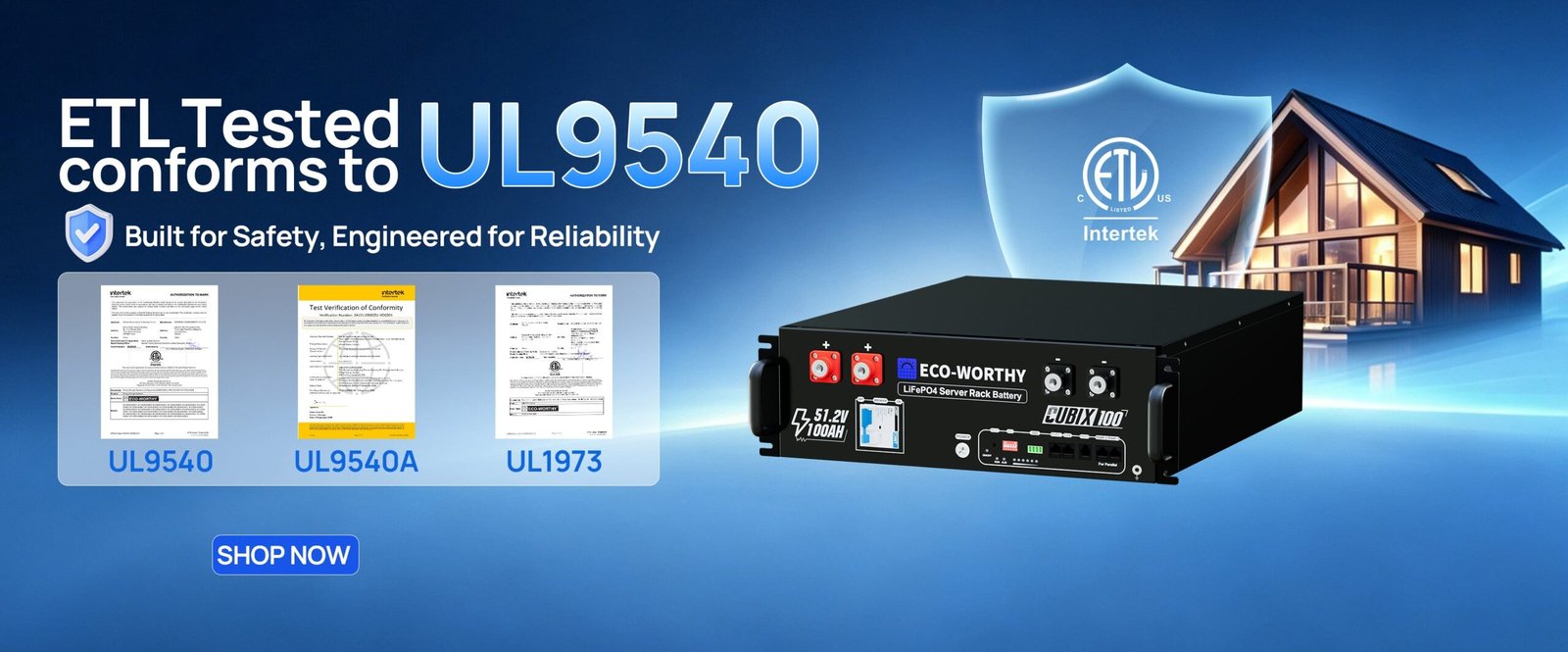
The Cubix100 series is designed for larger battery storage configurations. The listed 48V-class, 100Ah battery has a nominal voltage of 51.2V and a stated capacity of approximately 5.12kWh.
Its product listing highlights Bluetooth and Wi-Fi monitoring, battery management features, and a model-specific 10-year warranty.
Server-rack batteries may suit users assembling a modular energy storage system, but the physical rack, communication protocol, inverter compatibility, cable configuration, and parallel connection limits must all be considered.
PowerMega 314 battery
The PowerMega 314 is a larger wall-mounted energy storage battery listed with:
- Nominal voltage: 51.2V.
- Capacity: 314Ah.
- Advertised energy capacity: approximately 16.08kWh.
- A 200A smart battery management system.
- Active cell balancing.
- Bluetooth and Wi-Fi monitoring features.
The product page also describes integrated fire-suppression features and identifies the model as UL 1973 certified.
These are product-specific statements from ECO-WORTHY’s listing. Buyers planning a residential installation should obtain and verify the relevant certification documentation for the exact model and intended installation, rather than assume that certifications advertised for one battery apply to the entire product range.
3. Solar Charge Controllers
A charge controller regulates the electricity flowing from solar panels to a battery.
It helps ensure that the charging process stays within the electrical limits required by the battery and the controller itself.
ECO-WORTHY offers both PWM and MPPT charge controllers.
PWM charge controllers
PWM stands for Pulse Width Modulation. These controllers are generally associated with simpler and smaller solar setups.
They can be appropriate where system size and budget are the main considerations, provided the controller is correctly matched to the panel and battery configuration.
MPPT charge controllers
MPPT stands for Maximum Power Point Tracking.
An MPPT controller adjusts the electrical operating point of the solar panels to make better use of available solar power under changing conditions. It is commonly considered for larger or more demanding solar systems.
ECO-WORTHY lists products such as a 60A MPPT controller supporting 12V, 24V, 36V, and 48V battery systems, alongside smaller MPPT controllers with Bluetooth monitoring.
When choosing a controller, check:
- Supported battery voltage.
- Maximum PV input voltage.
- Maximum charging current.
- Supported battery chemistry.
- Maximum PV array wattage under the specified battery voltage.
- Required communication or temperature sensors, if applicable.
A controller with a high advertised amp rating is not automatically compatible with every solar array or battery.
4. Off-Grid and Hybrid Solar Inverters
An inverter converts DC electricity from a battery or solar system into AC electricity that can operate compatible household or commercial equipment.
This is an important component because the inverter determines how much electrical power the system can supply at a given time.
ECO-WORTHY offers several inverter categories:
- Smaller pure sine wave inverters for basic off-grid applications.
- All-in-one off-grid inverter systems.
- Split-phase inverters supporting specified 120V/240V configurations.
- Hybrid inverters for more advanced solar and battery installations.
One example is the ECO-WORTHY Liber 6kP split-phase inverter. Its product listing specifies 6,000W of rated continuous output, up to 9kW of solar input, and 120V/240V split-phase output.
Another example is the Liber 10KP, listed as a 10kW all-in-one split-phase inverter.
The correct inverter depends on more than its headline wattage. Buyers should compare continuous output, surge capacity, input voltage, supported battery configuration, PV input limits, operating modes, and the electrical requirements of connected equipment.
For household installations, wiring, grounding, overcurrent protection, transfer equipment, and local electrical requirements should be reviewed by a qualified installer.
5. Portable Power Stations
For customers who do not need a permanently installed solar system, ECO-WORTHY also offers portable power stations.
These products combine a battery, inverter, and output connections in one unit. They are designed to provide electricity for portable equipment and selected appliances without requiring a separate battery-and-inverter installation.
One listed product is the ECO-WORTHY 2400W Portable Power Station with a 2048Wh lithium battery.
Its advertised specifications indicate:
- Battery capacity: 2048Wh.
- Rated power output: 2400W.
This capacity and output combination gives buyers a straightforward starting point for comparing the product with other portable power stations.
However, the actual appliances it can operate depend on their continuous power consumption, startup requirements, and the station’s supported output connections.
Portable power stations are generally simpler to deploy than a full residential solar installation, but they have less flexibility than a properly designed modular system.
6. Complete Solar Kits and Home Backup Bundles
ECO-WORTHY also offers bundled systems intended to reduce the complexity of selecting individual components.
Its catalog includes complete off-grid solar kits, home backup bundles, and larger energy storage configurations.
Examples include:
- 400W 12V off-grid solar kits.
- 1560W and 2340W off-grid solar kits.
- Home backup bundles combining batteries and inverters.
- Larger systems built around the PowerMega 314 battery and higher-output inverters.
One listed home backup bundle combines a 51.2V 314Ah PowerMega battery, advertised at 16.08kWh, with a 10kW off-grid inverter.
The product page also describes expansion options and operation with multiple inverters.
A bundle can save research time because several components are offered together. However, buyers should still inspect the complete parts list. A solar bundle may not include every panel, cable, protective device, mounting component, transfer switch, or installation service required for the intended application.
How to Choose the Right ECO-WORTHY Solar System
The best system depends on what you need to power and how you plan to use it.
Step 1: Calculate your electricity consumption
Start by listing the appliances and devices you expect to operate.
For each device, record its power consumption in watts and the number of hours you expect to use it.
A basic energy estimate is:
Daily energy use (Wh) = Appliance power (W) × Operating hours
For example, an appliance using 100W for five hours consumes approximately 500Wh.
Repeat this calculation for each device and add the results to estimate total daily energy consumption.
Remember that actual energy requirements may be higher because of inverter losses and changes in appliance consumption.
Step 2: Choose an appropriate battery capacity
Battery capacity is measured in watt-hours (Wh) or kilowatt-hours (kWh).
A larger battery stores more energy, but not all its nominal capacity is necessarily available to the connected appliances. The usable energy depends on the battery’s operating limits, inverter efficiency, temperature, and system settings.
For a rough estimate:
Required nominal capacity ≈ Required usable energy ÷ Usable battery fraction
Use the battery manufacturer’s documented usable capacity and recommended operating limits when designing the system.
Step 3: Select an inverter with enough output
Battery capacity determines how much energy is stored. Inverter output determines how much power can be supplied at one time.
These are two different specifications.
For example, a battery with substantial kWh capacity may still be unsuitable for a high-power appliance if the inverter cannot supply its required wattage.
Pay attention to:
- Continuous rated output.
- Surge or startup capacity.
- AC voltage and frequency.
- Number and type of output circuits.
- Compatibility with the battery system.
Step 4: Match solar panels to the charge controller or inverter
Solar array sizing involves more than adding up the wattage printed on each panel.
Check the electrical characteristics of the complete panel string. The combined voltage and current must remain within the controller or inverter’s permitted input range.
When panels are connected in series, voltage increases. When connected in parallel, current increases.
Temperature can also affect panel voltage, so the design should account for the highest expected open-circuit voltage under the local conditions.
Step 5: Verify battery and inverter compatibility
Not every battery works with every inverter.
Check the nominal voltage, charging limits, discharge limits, communication protocols, and supported BMS settings.
For larger systems, confirm the approved battery models, maximum number of parallel batteries, cable requirements, and any firmware or communication configuration needed.
ECO-WORTHY provides product information and system-building resources, but buyers should verify the complete configuration before purchasing components separately.
Is ECO-WORTHY Suitable for DIY Solar Projects?
ECO-WORTHY’s range may be particularly relevant to customers who want to assemble or expand their own solar systems.
Rather than purchasing a single integrated energy product, buyers can select individual panels, batteries, charge controllers, and inverters based on their requirements.
This can offer flexibility when upgrading an RV system, building a remote cabin installation, or expanding a home battery setup.
However, DIY flexibility also creates additional responsibility.
The buyer must understand electrical compatibility, wire sizing, fuse and breaker selection, battery configuration, grounding, ventilation, and installation safety.
Larger residential systems should not be treated as simple plug-and-play equipment. Work involving household electrical circuits or grid connections should be designed and installed according to local codes by qualified professionals.
ECO-WORTHY Shipping, Returns, and Warranty
Before purchasing, buyers should review the policies for their specific region. ECO-WORTHY operates regional storefronts and warehouses, and shipping or warranty conditions may differ between markets.
Shipping policy
ECO-WORTHY’s general shipping policy states that it can ship to almost every country, with free shipping available for many destinations.
The policy lists:
- Order processing of approximately 1–3 business days.
- Estimated delivery of 3–5 business days for shipments from U.S. and Canadian warehouses.
- Estimated delivery of 3–7 business days for shipments from European, UK, and Australian warehouses.
- Approximately 5–14 business days for larger panel kits shipped by freight.
The general policy also describes a 60-day delivery guarantee for orders and a 30-day guarantee for shipments from several regional warehouses, subject to the stated exclusions and investigation process.
These delivery estimates are not guarantees of the actual arrival date for every order.
Large batteries and solar kits may require freight delivery, so buyers should confirm whether their address can accept pallet or truck shipments.
International buyers should check whether their country and selected product are eligible for delivery at checkout. A general statement that the brand ships internationally does not confirm availability for every item or destination.
Return policy
The U.S.-focused Shipping & Return Policies page describes two separate protections.
14-day defective-on-arrival guarantee
For items received damaged, incorrect, or not working, customers are instructed to contact ECO-WORTHY within 14 days and request return material authorization.
The original packaging is required for qualifying returns under this provision.
30-day no-reason returns
Eligible standard in-stock merchandise may be returned within 30 days of receipt.
The item must be in new and resalable condition, with its original packaging, manuals, warranty cards, and accessories.
ECO-WORTHY states that it covers return shipping for certain cases, including defective products, carrier damage, incorrect items, or products inconsistent with the advertisement.
For other return reasons, the customer is responsible for return shipping costs.
Because policies may differ by region and product type, buyers should read the applicable return terms before ordering.
Warranty coverage
ECO-WORTHY does not provide one universal warranty period for every product.
Its published warranty table lists different coverage for different product categories and specific models.
Examples include:
| Product category or model | Published warranty period |
|---|---|
| General PV modules | 1 year |
| Charge controllers | 1 year |
| General inverters | 1 year |
| General LFP batteries | 3 years |
| Cubix100 server-rack batteries | 10 years |
| Wallbank series batteries | 10 years |
| PowerMega 314 series | 10 years |
| PowerNEO 314Ah series | 5 years |
| Liber 5kW/10kW/18kW off-grid inverter series | 2 years |
| Liber 6kP inverter | 2 years |
| Synch 12KP hybrid inverter | 5 years |
| Certain 410W and 590W solar panels | 10 years |
These examples come from the published warranty schedule. The exact terms for the selected SKU should always be checked before purchase.
An important limitation is that the warranty page states that its policy applies only to products located in the continental United States and is valid only for the original purchaser. It also states that labor is not covered.
International buyers should request written confirmation of the warranty arrangements that apply to their regional storefront, delivery destination, and exact product.
Read the current ECO-WORTHY Warranty Policy before purchasing.
What Do Customers Say About ECO-WORTHY?
Public customer feedback provides an additional perspective, although individual experiences should not be treated as a guarantee of future product performance.
Recent Trustpilot review summaries mention positive experiences with solar panels and batteries, including reports of products arriving quickly and working as expected. Some customers also describe helpful support when dealing with product questions.
Other reviewers report delayed deliveries, slow or unhelpful email responses, difficulties resolving warranty issues, and concerns about shipping packaging.
These mixed experiences suggest that buyers should evaluate both the product specifications and the after-sales process.
For a larger battery or home backup purchase, it is especially important to keep order records, confirm the warranty in writing, and understand how technical support and replacement procedures work.
You can read current customer experiences on Trustpilot’s ECO-WORTHY review page.
Advantages and Limitations of ECO-WORTHY
Potential advantages
Broad product selection: ECO-WORTHY offers several components needed to build an off-grid or battery-based solar system, including panels, batteries, controllers, and inverters.
Multiple battery configurations: Its product range includes 12V, 24V, and 48V-class LiFePO4 batteries for different applications.
Options for larger installations: Server-rack batteries, high-capacity wall-mounted batteries, and larger inverter bundles provide options beyond basic portable power.
Individual components and complete kits: Buyers can choose between selecting each component separately and purchasing a bundled system.
Regional shipping network: The company lists warehouses in several regions, which may help reduce delivery times for eligible orders.
Points to consider
System compatibility requires careful planning: Voltage, current, BMS communication, PV input limits, and inverter specifications must all match.
Warranty terms differ by product: A 10-year warranty on a specific battery does not mean every ECO-WORTHY product receives the same coverage.
International warranty coverage needs confirmation: The published warranty page includes a continental U.S. limitation.
Freight shipping may be required: Large solar panels and battery systems can involve more complex delivery arrangements than ordinary parcels.
Technical installation is not always simple: Larger home energy systems require appropriate electrical protection and qualified installation.
Is ECO-WORTHY Worth Considering?
ECO-WORTHY is worth considering for shoppers looking for solar panels, LiFePO4 batteries, charge controllers, inverters, and complete off-grid energy systems.
Its strongest appeal is the breadth of its product ecosystem. Customers can select small solar components for an RV or build toward a larger battery-backed installation using compatible batteries, inverters, and solar arrays.
The brand may be especially relevant to technically confident buyers who understand system sizing and want flexibility in choosing individual components.
For buyers who prefer a simple, fully integrated backup product, a portable power station may be easier to manage than a custom battery-and-inverter installation.
Before ordering, compare the exact specifications, confirm component compatibility, review the model-specific warranty, and verify shipping and service arrangements for your country.
Official Website: https://www.eco-worthy.com/
Affiliate Disclosure: This article may contain affiliate links. CatchOffers may earn a commission when readers make qualifying purchases through these links, at no additional cost to them.

